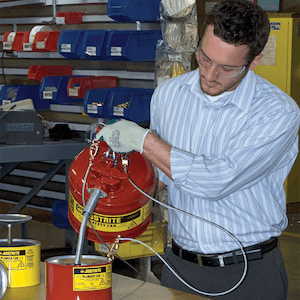
Justrite flammable safety cans include many features to prevent fires or injuries when working with flammable liquids. Automatic positive pressure relief vents between 3 and 5 psi to relieve pressure and avoid an explosion. Flame arresters dissipate heat to stop flashback ignition. Type II safety cans include hoses to make it easy to pour into narrow openings, reducing the chance of spillage.
Working with flammable, and combustible or corrosive liquids can be confusing and dangerous. To ensure a safe workplace, there are many regulations that apply to their storage, handling and dispensing. Besides the obvious safety risks, fires and explosions can also cause property damage, financial losses and environmental incidents.
Understanding the difference between spill containment and secondary containment is essential in maintaining a safe and regulation-compliant working environment wherever hazardous materials are found. Both forms of containment serve an important role in workplaces around the globe, protecting employees and the environment from dangerous liquids.
According to an overview of citations issued by the Occupational Safety and Health Administration (OSHA), facilities in the food and beverage industry received a total of 1,177 citations between the months of October 2020 and September 2021. These citations amounted to a total of $8,575,378 in fines for facilities.
For the health and safety of your workers and the continuity of your business, it is imperative to be as prepared as possible for natural disasters. Justrite helps you be ready when natural disasters strikes.
Eyewash stations and safety showers are often overlooked in the foodservice industry. People tend to think that these stations are for applications that involve the use of dangerous chemicals or materials. However, the regulations concerning these fixtures could apply to your restaurant or eatery.
The process of bonding one or more conductive objects to the ground, so that all objects are at the same static potential as earth; also referred to as "earthing." The process of connecting two or more conductive objects together by means of a conductor so that they are at the same static potential, but not necessarily at the same potential as the earth.
Approved safety cans, as required by OSHA, are found in many different industries and facilities. They provide a safe and convenient method of moving, dispensing, or temporarily storing up to 5 gallons of flammable liquids.
Workplace spills should be promptly taken care of, so it's important to keep effective spill containment equipment in your facility. But how do you clean the equipment after use? Learn best practices for emptying and cleaning a spill containment berm from our safety experts.
As reported by Reuters in its 2014 article, AT&T reached a settlement with the state of California to pay $52 million in penalties and environmental compliance. Investigators found the company illegally disposed of hazardous waste (including aerosol can disposal) at facilities across the state over a nine-year period. They sent this waste to ordinary landfill sites not permitted to receive contaminants.